
Why Critical Thinking Is The Secret Weapon Behind College Success (And How It Can TRANSFORM Your Grades)

This post about how critical thinking can transform your grades in college contains a paid collaboration with Tuttle Twins.
We all know the phrase "the real world" is just around the corner when you’re in college. It’s the time when the easy answers of high school—the multiple-choice tests and the simple memorization—start to fade away.
Being in college means collecting facts and learning how to use them, challenge them, and build something new with them.
The single most important skill that separates successful college students from those who struggle is critical thinking. It's not an elective course you can skip; it's the operating system for your entire college education and, frankly, the rest of your life.
What Does "Thinking Critically" Actually Mean?

If you ask a hundred students what critical thinking is, you'll get a hundred slightly different answers. That's because it's a dynamic skill set, not a single action. At its core, critical thinking is the ability to analyze information objectively and make a reasoned judgment.
Think of it as the ultimate quality-control process for your brain. It means you don't just accept information at face value. Instead, you stop, ask tough questions, and dive deeper.
It involves several key steps:
Analysis: Breaking a complex topic or argument down into its constituent parts to understand how they relate.
Evaluation: Assessing the reliability, relevance, and validity of evidence and sources. Is this information credible? Is the source biased?
Inference: Drawing reasonable conclusions from the information you have analyzed and evaluated.
Explanation: Clearly and logically communicating your findings and the reasoning behind your conclusions.
This process transforms you from a passive recipient of information into an active participant in your own education.
And the best part? It’s a skill you can start building early. This is why educational resources that teach foundational reasoning skills are so important, even for the youngest learners.
For example, the Tuttle Twins books introduce big ideas in a way that sparks curiosity and encourages little ones to ask why things are the way they are. You can find their full range of children’s books and resources at Tuttle Twins.
The College-Level Shift: Moving Beyond Memorization
In high school, you could often succeed by simply memorizing dates, formulas, and vocabulary. College flips that script. Professors don’t just want to know if you can recall information; they want to know if you can engage with it.
Consider the difference in these two learning styles:
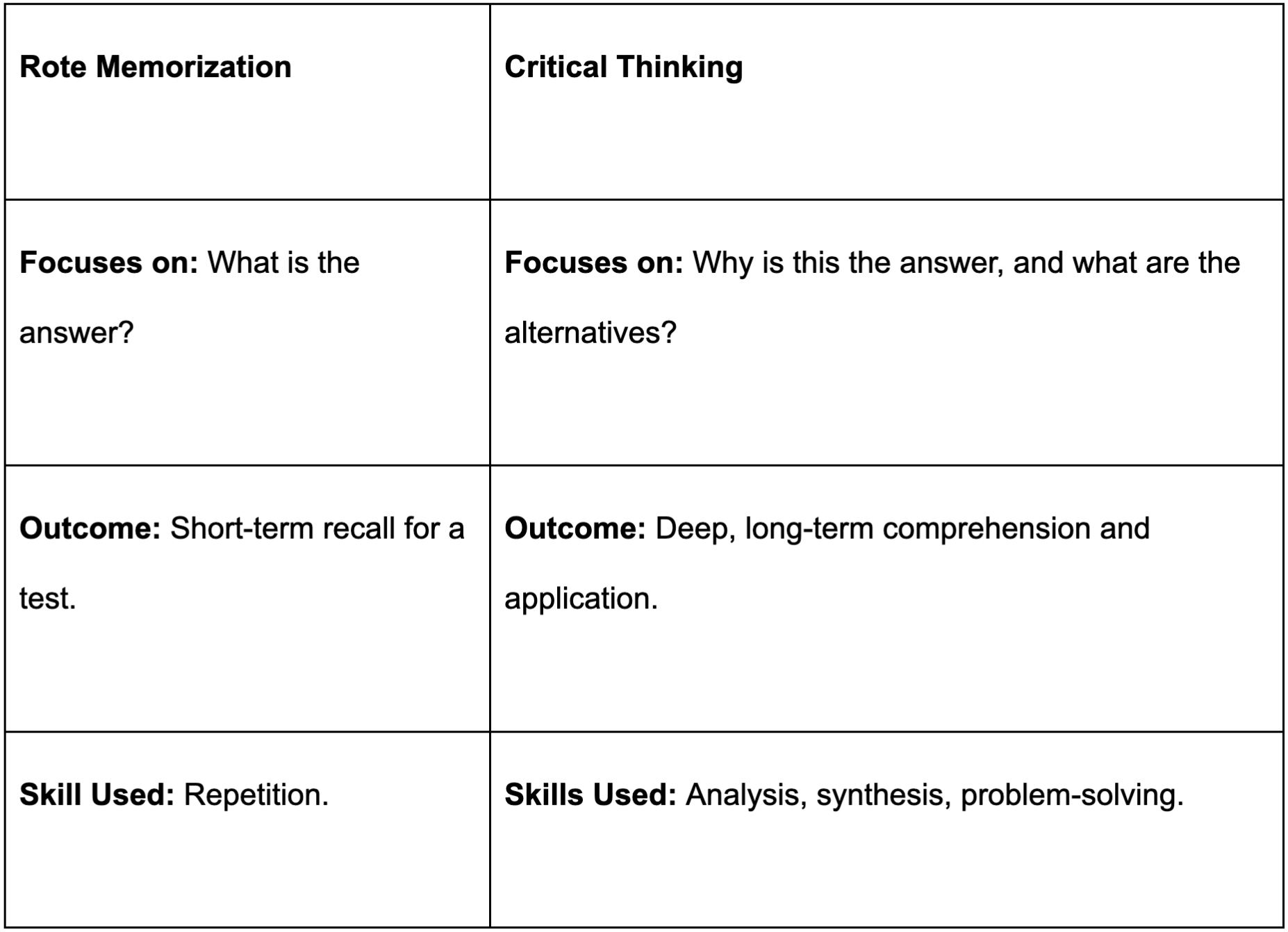
In a college history class, you don't just memorize the date the Civil War began. A critical thinker asks: What were the long-term economic and social factors that led to the war?
How do the perspectives of different historical figures—or different historians—differ? Which sources are most reliable, and why? This level of inquiry is what earns you an 'A' on a university essay.
Related: How To Be Productive In College (12 Hacks For Busy Students)
How Critical Thinking Elevates Your Academic Performance

Your ability to think critically touches every single assignment, lecture, and test in college. It’s the difference between merely surviving your coursework and absolutely thriving in it.
#1: Mastering The Research Paper
The research paper is the ultimate critical thinking marathon. You start with a broad topic and must narrow it down, formulate a unique thesis, and then find credible sources to support it.
Evaluating Sources: In the digital age, everyone has a platform. Critical thinking helps you filter out the noise. You learn to spot biases, verify credentials, and determine if an article from a niche blog is as credible as one from a peer-reviewed academic journal. You look for vested interests—does the person or organization sharing the information have a financial or personal stake in persuading you of a certain viewpoint?
Building a Logical Argument: You don't just string together quotes. You use analysis to connect the dots between your evidence and your thesis, building a compelling, well-supported case that anticipates and addresses counter-arguments.
#2: Excelling In Class Discussions And Debates
College seminars and discussions are where critical thinking shines in real-time. Simply restating what the textbook said isn't engaging. A critical thinker contributes by:
Asking Probing Questions: They challenge assumptions. Instead of asking "What is the policy?" they ask, "What are the unintended consequences of this policy, and for whom?"
Synthesizing Diverse Viewpoints: They listen actively, process the different ideas shared by their peers, and then construct a response that thoughtfully incorporates or refutes those perspectives. This shows a deep engagement with the material, not just a surface-level understanding.
#3: Solving Complex Problems (In Any Field)
Whether you’re in engineering, business, or the humanities, college presents you with problems that have no single, obvious answer.
In Engineering: You can’t just use the formula you memorized. You must analyze the unique constraints of the problem, evaluate the trade-offs between different solutions, and infer the most efficient and safe design.
In Business: You don't just report data. You interpret the implications of that data—what patterns are emerging, and what are the best recommendations based on that analysis? Critical thinking transforms data into actionable strategy.
Strategies To Sharpen Your Critical Thinking Skills
The great news is that critical thinking is not an innate talent; it’s a muscle you can train and strengthen. Here are a few practical habits to adopt immediately:
#1: Adopt A "Curious" Mindset
Start asking "Why?" and "How do we know that?" about everything you read and hear. Assume nothing is settled fact until you have thoroughly examined the evidence. This habit shifts your brain from passive acceptance to active inquiry.
#2: Practice Metacognition (Thinking About Your Thinking)
This is a powerful technique. After you've completed an assignment or solved a problem, take time to reflect on the process:
How did I arrive at this conclusion?
What assumptions did I make?
What information might be missing?
If I had a counter-argument to my own point, what would it be?
This self-reflection helps you identify the flaws and biases in your own reasoning, allowing you to refine your cognitive strategy for the next challenge.
#3: Engage In Debate And Discussion
Seek out peers who hold different viewpoints and engage in civil, constructive discourse. Debating forces you to articulate your reasoning clearly and, more importantly, to understand the logical structure of an opposing argument. It’s an exercise in mental flexibility and objective analysis.
#4: Become A Media Skeptic
In a world overflowing with information, you must become a sophisticated consumer of media. When you see a shocking headline or a persuasive social media post, make it a point to:
Read Past The Headline: Often, the article's contents do not fully support the sensational title.
Cross-Reference: Check the facts against multiple, respected news or academic sources.
Identify Bias: Consider the source's political leanings, funding, and general audience. Acknowledging bias doesn't mean rejecting the source, but it means reading the information with a necessary layer of skepticism.
The Lifetime Return On Investment

The skills you hone through critical thinking in college are the same ones employers consistently rank as the most desirable: complex problem-solving, analytical reasoning, and effective communication.
A degree is a wonderful thing, but a diploma simply says you completed a course of study. Critical thinking, on the other hand, says you are ready to lead and innovate. It empowers you to navigate complex professional challenges, make sound financial decisions, and engage as a responsible, informed citizen in a complex world.
College is the training ground, but critical thinking is the tool that ensures your academic success translates into real-world impact. Start sharpening that tool today.
Related: 10 Ways To Beat Academic Burnout In College! (& Avoid It)
Closing Thoughts
Thank you for reading “Why Critical Thinking Is The Secret Weapon Behind College Success (And How It Can TRANSFORM Your Grades).”
For handmade digital art prints, icon packs, wallpapers, & more designed by me, be sure to stop by my digital boutique: Designed By Nikki Lo.
Connect with me!